
Skip to content
AI StrategyJune 16, 20267 min read

Do Not Build Production AI On One Model

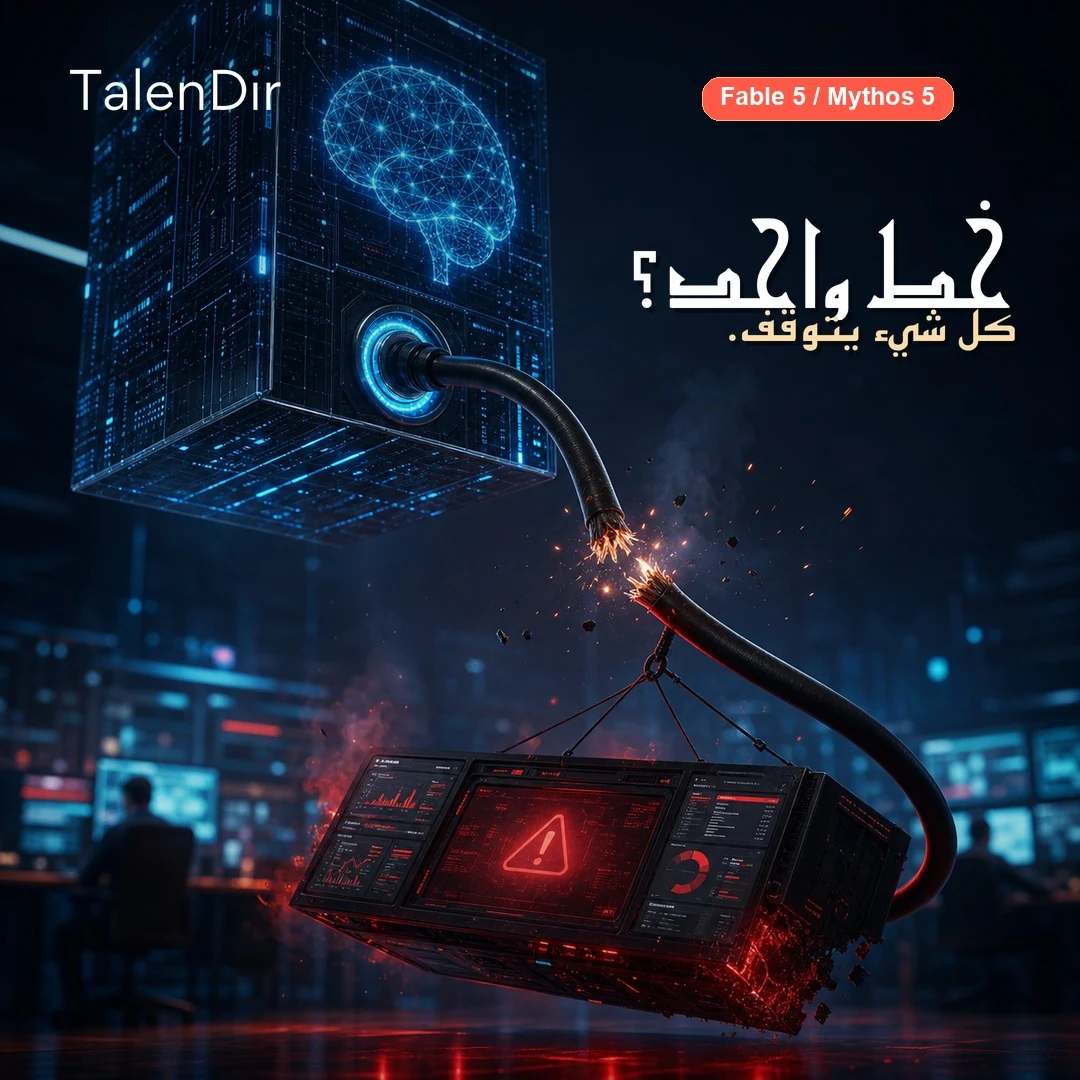
The Fable 5 and Mythos 5 access suspension is a production AI warning: do not depend on one LLM, one provider, or one jurisdiction.

Do Not Build Production AI On One Model

A frontier model can be excellent on Monday and unavailable by Friday.

That is the uncomfortable production lesson from the Fable 5 and Mythos 5 access suspension. The shock is not only that two major AI models were suspended. The deeper shock is that access to a production dependency can change at the blink of an eye because of policy, compliance, security claims, export controls, provider decisions, pricing, infrastructure, or jurisdiction.

This is not an argument against Anthropic. It is not an argument against Claude, OpenAI, Gemini, or any other serious AI provider. Strong providers are useful. Frontier models are useful. The mistake is different: treating one external model as if it is the product.

If your production AI system depends on one LLM, one provider, one API path, and one regulatory environment, you have not built resilience. You have built a single point of failure with a polished interface.

What Happened

On June 12, 2026, Anthropic published a statement saying the US government had issued an export-control directive requiring suspension of access to Fable 5 and Mythos 5. Anthropic said it had to disable access for customers in order to comply, while access to its other models would not be affected.

Anthropic also disputed the basis it had been given. Its statement framed the issue as a narrow potential jailbreak concern rather than proof of a broad model recall-level risk. The company said it was complying with the directive while working to restore access.

Indian Express later reported on June 16, 2026 that the impact could reach users outside the United States, and that an attempted access check from India showed Fable 5 as currently unavailable.

Those details matter. But the production lesson does not depend on who is right in the dispute. A customer building on top of a model is rarely in control of the legal, geopolitical, safety, and commercial forces around that model.

Your product still has to work.

The Wrong Lesson Is "Avoid One Provider"

The lazy reaction is to say: "Do not use Anthropic."

That is the wrong lesson.

Every major AI provider lives inside constraints: national policy, export law, safety policy, cloud infrastructure, model release strategy, pricing pressure, and commercial priorities. The name on the API can change, but the dependency pattern remains.

Today the incident is Fable 5 and Mythos 5. Tomorrow it could be a pricing shift, a regional availability change, a quota policy, a moderation update, a latency regression, a terms-of-service change, a data-retention requirement, or a model replacement that behaves differently on your hardest tasks.

The serious question is not:

Which provider should we trust forever?

The serious question is:

What happens to our users if our best model is not available tomorrow?

Where Single-Provider Risk Shows Up

Single-provider risk is not always obvious in a dashboard. It usually hides inside product assumptions.

It shows up when one prompt has been tuned so tightly to one model that every other model performs badly.

It shows up when a workflow calls a model directly from business logic instead of going through an internal routing layer.

It shows up when the team has no eval set, so no one knows whether a fallback response is acceptable, risky, or quietly wrong.

It shows up when customer support has no incident language for degraded AI output.

It shows up when the product promise is "instant expert output" and there is no lower-depth mode, delayed mode, human review mode, cached guidance, or manual path.

It shows up when a company has user data but no labeling standards, no task definitions, no quality benchmarks, and no owned knowledge structure.

That may be fine for a demo. It is not fine for production.

Build More Than One Route

If your team is building AI into hiring, careers, education, support, search, or operations, the goal is not to chase every new model headline. The goal is to build systems that keep working when the market changes.

Use Talendir's journal and Talin to think about skills, work signals, and practical AI with stronger judgment. The future of work will not be shaped only by who uses the strongest tool today. It will be shaped by who can keep quality high when the toolchain changes.

What A More Resilient AI Stack Looks Like

A serious production AI stack needs options by design.

First, separate product logic from provider logic. Your application should understand the task it is trying to solve: classify, summarize, rank, explain, extract, coach, draft, review, search, or route. It should not have model names scattered through the codebase as if the provider is part of the product domain.

Second, build routing. Not every task needs the strongest model. Some tasks need speed. Some need cost control. Some need stronger reasoning. Some need stricter privacy. Some can run on a smaller model. Some should go to human review. A good architecture sends the right task to the right path.

Third, maintain fallback models. A fallback is not a spare name in a config file. It is a tested path with known quality tradeoffs. If the primary model disappears, the product should know which tasks can continue normally, which should run at reduced depth, which should queue, and which should stop.

Fourth, run evals before switching. Without evals, a fallback can create false confidence. The system may keep responding while quality drops below the level a human process would have delivered. Production teams need test sets, edge cases, regression checks, human review samples, and clear acceptance thresholds.

Fifth, design graceful degradation. If the best model is unavailable, the user experience should not collapse. The product can offer delayed processing, reduced answer depth, cached guidance, manual review, a transparent queue, or a clear message that the high-precision feature is temporarily limited.

Sixth, keep an incident mode. Teams need prepared language, internal ownership, monitoring, and escalation paths. AI incidents are not only infrastructure incidents. They can be quality incidents, trust incidents, privacy incidents, compliance incidents, or reputation incidents.

Owned Capability Is The Long Game

Not every company needs to train a frontier model. Most should not.

But every serious company building with AI should own more than prompts. It should own its data discipline, labeling standards, workflow definitions, evaluation sets, quality thresholds, domain vocabulary, policy decisions, and knowledge structure.

Those assets make a company less fragile.

When the provider changes, a company with strong internal evals can compare models quickly. A company with clean task definitions can reroute work. A company with labeled examples can tune smaller models or build retrieval systems. A company with clear quality standards can explain why an output is good or bad.

That is what owned capability means in practice. It is not a slogan about sovereignty. It is the ability to keep judgment inside the organization even when the model is rented.

The Skills Lesson

This is also a talent issue.

The strongest teams in the AI era will not be the teams that memorize one tool. They will understand model behavior, quality control, privacy, routing, fallback, evaluation, policy risk, and user trust.

They will know when a stronger model is worth the cost, when a cheaper model is enough, when a human should stay in the loop, and when an AI feature should degrade instead of pretending nothing changed.

That is a different kind of skill. It is less about prompt tricks and more about production judgment.

For candidates, this means the valuable AI skill is not only "I can use the latest model." The stronger signal is: "I can help a team use AI safely, reliably, and with options."

For companies, it means AI hiring should look for people who can reason about systems, not only tools.

The Question Every AI Product Needs To Answer

Before a company ships an AI feature into production, it should answer one question in plain language:

What happens if our primary model disappears tomorrow?

If the answer is "the product breaks," the architecture is not ready.

If the answer is "we switch providers manually and hope quality holds," the architecture is still weak.

If the answer includes routing, evals, fallback paths, user messaging, graceful degradation, data ownership, and human review where needed, the product is closer to production maturity.

The Fable 5 and Mythos 5 story will keep evolving. Access may return. The policy fight may change. The technical details may become clearer.

But the production lesson is already clear.

Do not build the future of your product on one model.

Build with options.

Ending CTA

Talendir will keep publishing practical analysis on AI, work, hiring, and skills for people and teams who want to build with more judgment. Follow Talendir and read the journal for sharper signals on what changes next.

Sources

Share this article

Share this article with others.